
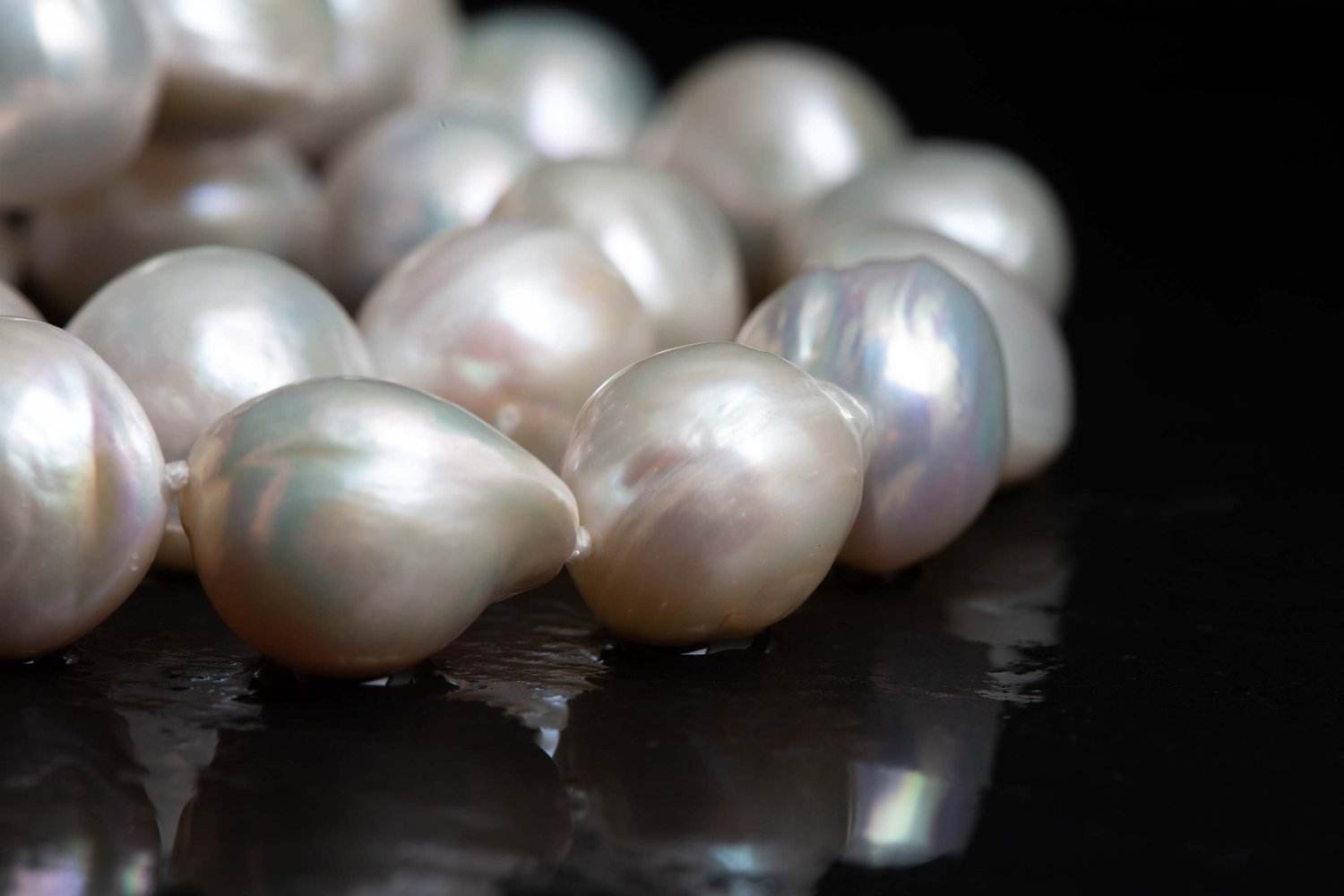
The raw, wild beauty of Baroque pearls is a gift from nature to those who love natural beauty, accept imperfections according to common standards to create a beautiful, attractive, unique lifestyle of their own.
Gone is the concept of beauty following a certain standard as fashion houses are gradually moving towards individuality. The freedom and “unique” design of baroque pearls bring a new breeze to all popular fashion styles in the world.
Pearls are the only gemstones created from living organisms. During the mining process, round pearls are considered traditional pearls. Other shapes are called baroque pearls. Round pearls are loved for their elegance and perfection. Meanwhile, raw pearl jewelry with a modern and unique breath is showing signs of strong dominance.
"Pearls are appropriate for every occasion" - Jackie Kennedy
Pearls, according to shape, are divided into three main types: 1. Round (perfect) pearls 2. Symmetrical pearls (when cut in half, each half will be a mirror image of the other half) 3. Heteromorphic pearls (also known as Baroque heteromorphic pearls).

Pearls, when mentioned, we easily associate them with the perfect round shape, the perfect surface and the irresistible luster. But in fact, like all things born from nature, pearls are diverse in shape: imperfect round pearls, tear-shaped pearls, long and slender pearls, asymmetrical gems and many other forms - all are unique and perfect pearls in their own way.

History of Baroque Rough Pearls
A rough pearl (also known as a freak pearl, a freak pearl) is a pearl that has unusual variations in color, shape, or structure compared to a normal pearl. These variations often appear due to the impact of special environmental or genetic factors during the pearl formation process. These are the unique and charming Baroque pearls. The term “baroque” is commonly used to refer to pearls that are not round.
Raw pearls impress with their novel and unique shapes and sizes.

The most expensive pearl in the world is a Baroque pearl called the Giga Pearl. It weighs 75 pounds and is worth up to $200 million.
The term 'Baroque' comes from the Portuguese word 'Barocco', which means 'imperfect'. The term was first used in relation to pearls in a French dictionary from the late 17th century, describing a gemstone that was imperfectly shaped (not round). Baroque pearls became very popular during the Renaissance, when jewellers prized them for their unique and natural beauty. During this period, Baroque pearls were mainly used in the creation of miniature figures, in which the pearls were used as actual body parts. The most prominent example is a 16th-century work called 'The Canning Jewel', in which a large Baroque pearl was used as the upper body of a mermaid. ( see here )

Johannes Vermeer's famous painting 'Girl with a Pearl Earring' depicts a young girl wearing a large Baroque pearl. The painting, known as the 'Mona Lisa of Northern Europe', was painted in the 17th century, during the Dutch Golden Age.

Johannes Vermeer's famous painting 'Girl with a Pearl Earring' depicts a young girl wearing a large Baroque pearl
The most famous Baroque pearl in the world is none other than 'La Peregrina'. This pearl has a long and rich history since its discovery in Panama in the 16th century. It was once owned by Napoleon, as well as British royals, it has been lost and then found many times, only to fall into the hands of Hollywood artists and celebrities.


"La Peregrina" is set in an exquisite jewelry necklace, valued at up to $11.8 million.
Baroque pearl varieties:
With a beauty that blends classic inspiration and current beauty concepts, the raw pearl trend is certainly indispensable in the fashion dictionary of fashionistas. Pearl jewelry of different sizes can bring elegance to many styles of clothing, helping you "upgrade" your style in the new fashion season.
Most freshwater pearls are actually Baroque pearls. In fact, over 90% of freshwater pearls are Baroque, with less than 10% of freshwater pearls being round. This means that the typical shape of a freshwater pearl is actually not perfectly round or imperfect, but Baroque. This explains why round pearls are more valuable – they are simply rarer, and the majority are natural. Saltwater pearls, as well as cultured and natural, also come in Baroque shapes. Even some Akoya pearls, which are known for their perfectly round specimens, are Baroque, but the percentage is not as high as that of freshwater pearls.
“All works of art are autobiographies of their author; the pearl is the autobiography of the oyster.” - Frederico Fellini
Pearl formation does not always occur in soft tissue. Some pearl follicles become trapped in muscle tissue, where they encounter resistance from the surrounding muscles, eventually resulting in irregular, imperfect pearl shapes. Most freshwater pearls are Baroque because these pearls are produced by nucleation of gill tissue and not by nucleation of beads. As for non-round seawater pearls, Akoya pearls are rare, while South Sea Baroque pearls and Tahitian pearls (although often tear-shaped) are available and valuable. The latter two are produced by Pinctada Maxima (oysters and white-lipped oysters) and Pinctada Margaritifera (black-lipped oysters). Nearly half of all cultivated Tahitian pearls are Baroque and Semi-Baroque (slightly irregular in shape). While Baroque pearls have irregularities throughout, Semi-Baroque pearls are often more symmetrical in shape (such as oval or round), with irregularities usually found at one end.

Most black Baroque pearls are grown in Tahiti.

While most South Sea Baroque pearls come from Australia.
Baroque pearls are inherently unpleasant pearls because of their slightly rough appearance. To create a complete product made from malformed pearls is an elaborate process, requiring meticulousness in the selection stage and creativity in the design stage. Because of the characteristics of this type of pearl, they are very popular in the semi-classical and impressive art schools such as Victoria and Art Nouveau to modernize the design and break away from previous stereotypes.
Meet Baroque Pearls, also known as the gems of the sea that are not perfectly round, have irregular shapes, uneven surfaces, but they are no less charming than their symmetrical pearls. Baroque Pearls, the name itself gives us an idea of the shape of the pearl: not round, not perfect according to the traditional round standard, but each pearl is born in a unique shape, no two are alike: Leaf Pearls, Coin Pearls, Cross Pearls, Egg Pearls, Rice Pearls, Keshi Pearls...

(Image Courtesy of Australian National Maritime Museum)
Some examples of heterogeneous pearls include:
-
Unusual colored pearls: Instead of being white or natural color, heterozygous pearls can be unusual colors such as blue, black, yellow, or even pink.
Irregular Shape: Pearls are usually round or semi-round in shape. However, heterogeneous pearls can be irregular in shape, asymmetrical, or have many unique features.
-
Unusual structure: Heterogenous pearls may have an internal structure that is different from that of a normal pearl, such as multiple shells, an irregular shape, or an irregular gritty structure.

There are four main types of pearl shapes: Round, Drop, Baroque, and Circle Baroque (a subtype). There is also a wide variety of shapes when it comes to these pearls. Because of their wide range, each subtype is favored in creating specific jewelry pieces, from romantic jewelry to religious jewelry. Used as jewelry pieces in designs that feature many different pearls or as their own standout pearl, baroque pearls are incredibly versatile. Here are twelve shapes of Baroque pearls, which can be divided into 12 different categories.
1. Coin Pearls:
Coin pearls are round and flat, like a coin. Because of their large flat surface area, coin pearls have a distinctive luster and are often used in jewelry.

2. Baroque Pearls:
This is the general name for pearls that are not round and are also a subtype. Elongated spherical pearls are called Baroque pearls, and are often concave and irregular in shape. These pearls were used a lot in Victorian and Art Nouveau pieces.

3. Twin Pearls:
When two pearls come together, they are called double pearls. They can be similar in shape or one side can be larger than the other. Double Pearls are often used as stud earrings.

4. Potato Pearls:
Potato pearls are small and bumpy, and, as the name suggests, resemble a small potato. These are the smallest of the Baroque pearls. They are not elongated, like the other Baroque shaped ones; instead, they are small and often square, rounder, or bumpy. Potato pearls are ideal for making Baroque pearl bracelets and necklaces.

5. Cross Pearls:
Cross pearls are rare, but they are prized in religious jewelry. As the name suggests, natural cross pearls form in the shape of a cross. They are true wonders of the natural world.

6. Stick Pearls:
Stick pearls are also known as BIWA pearls. The main characteristic of Stick pearls is that they are long, flat and narrow, like a stick. The pearls are absolutely stunning, and can easily be used for statement jewelry because of their unique shape.

7. Rice Pearls:
Rice pearls are small pearls that resemble grains of rice. They are round, but not perfect. They are quite close to traditional pearls because they are rounded, but still not perfect. They are often drilled centrally and are used for Baroque necklaces and Baroque bracelets.

8. Egg Pearls:
With a wide base and narrow top, egg pearls resemble small eggs, as the name suggests. They are often drilled vertically to preserve and highlight their unique shape.

9. Heart Pearls:
Heart pearls are similar to coin pearls, but are heart shaped, making them suitable for romantic jewelry. They are highly prized in the jewelry making business because they can be used to create romantic baroque pearl pendants .

10. Teardrop Pearls:
Teardrop pearls are pear shaped and are often used in ear jewelry. They are highly prized and often more valuable than other Baroque pearls because of their extremely delicate beauty and are often used for luxury earrings.

11. Leaf Pearls:
Leaf pearls have a thin, irregular papery surface. They are the thinnest and thinnest type of Baroque pearls. They are papery with a very bumpy, uneven surface. They can be used for a variety of jewelry, including bracelets, necklaces, and earrings.

12. Keshi Pearls:
Keshi pearls are a rare type of Baroque pearl. They are created when the oyster sheds its nucleus but continues to grow the pearl, so Keshi pearls have no nucleus. They have a distinctive elongated and sparkling appearance, are composed mainly of nacre and appear to be elongated and have an extraordinary luster. Few people know that Keshi pearls are actually made up of nacre only. They are the most highly prized baroque pearls on the jewelry market.


Value of Baroque pearls:
Due to their unusual shape, Baroque pearls cannot be valued by the same standards as traditional pearls. While some criteria are used to analyze both types of pearls, there is a very different interpretation of the value of Baroque pearls.
Style: The type of pearl that appears Baroque is always the main factor that determines its value. While the vast majority of deformed pearls are freshwater pearls, for example, their value is much lower than that of baroque Akoya pearls.
-
Shape: While traditional pearls are valued by how round they are, baroque pearls are analyzed by the specific shape they have. As we explained above, the most valuable baroque pearls are keshi pearls, baroque pearls, and cross pearls.
Size: Whether it is a traditional or irregular shape, the size of a pearl will always be extremely important in determining its value. As for classic pearls, the larger the pearl, the more valuable it is.
-
Color: Baroque pearls are used to create a wide range of jewelry. As such, the color of the pearl is important in determining its value. Since most pearls are irregular in color or white, salmon, and pink, dark pearls are the most valuable because they are extremely rare.
Luster: Pearl luster is determined by how well they can reflect light. Coin pearls and Keshi pearls are the most valuable pearls because they have the best luster of the entire category.
Anomalous pearls are prized for their rarity and uniqueness, and they can be highly valuable in the jewelry and pearl collecting markets:
Why are Baroque pearls so popular?
There are many benefits to choosing baroque pearls – keep reading to learn about the key points.
- Unique appeal: Baroque pearls have a unique and distinctive shape, creating a distinct and unique appeal and charm. Today, the imperfections of these pearls are no longer seen as a weakness. Instead, designers and buyers celebrate the natural and individual beauty of irregular pearls.
- Self-Expression: Because of their uniqueness, Baroque pearls allow the wearer to express their style in a non-traditional way. While they are still precious gems, their distinct shape and appeal make wearing these pearls a uniquely personal experience.
- Affordable: One of the more practical benefits of choosing Baroque and semi-Baroque pearls is that they are less expensive than regular round pearls. At half or a third the price of round pearls, Baroque pearls offer pearl lovers the opportunity to own truly precious gems at a more affordable price.
- Artistic value - beautiful colors and sparkle: Baroque pearls are considered natural works of art for art lovers and natural jewelry lovers. They represent the diversity and whimsy of nature for people to constantly learn and explore. What is extremely interesting about Baroque pearls that few people know is that the uneven, uneven shape of the actual pearl highlights its own sparkle and diverse light. The same happens with the color of the pearls, especially Tahitian pearls. Each pearl exhibits a range of colors within a single pearl, creating polychromy and different tones from different angles. The grooves and irregular surfaces further enhance the sparkle due to the light reflecting from all angles.
- Collectibles: Collectors often value unusual pearls, as they are often interesting pieces in their collections.
Frequently asked questions when choosing Baroque pearls:
Are Baroque Pearls Valuable?
Baroque pearls are real pearls, which means they are valuable. However, not all Baroque pearls are the same. In general, Baroque pearls are less expensive than round pearls, but their value depends a lot on the specific pearl type. Freshwater Baroque pearls (which are widely available) are often much cheaper than Tahitian black pearls or South Sea Baroque pearls. Round pearls are usually about 25-35% more expensive than round pearls of similar type and size.
Are Baroque Pearls Fake?
Both real and fake Baroque pearls can be found on the market. The easiest way to test if your pearl is real is to gently rub it along the surface of your tooth. Real Baroque pearls will have a rough texture, while fake pearls (including glass and plastic) will be completely smooth. Furthermore, pearl jewelry pieces that you notice all of the Baroque pearls look the same in shape or have grooves that appear to be intentional rather than natural may be fake.
How to price Baroque pearls?
There are many factors that contribute to the price of a Baroque pearl: brilliance, size, pearl type, and color. The brightness of the light reflected is an important factor. In terms of color, darker tones are generally more valuable than lighter tones because they are rarer. Large pearls with desirable shapes (such as teardrops or shapes with a certain symmetry) are more valuable than small pearls with significant deformities.
While traditional pearls are aimed at ladies who love perfect and standard beauty, Baroque pearls are the ideal choice for those who love innovation, personality and uniqueness. Each Baroque pearl has its own unique beauty, cannot be found anywhere else, is the embodiment of uniqueness. It is the uniqueness and imperfection according to personality that has turned Baroque pearls into favorite and valuable jewelry in collections, attracting those who love difference.
#pearls #baroquepearls
0 comments