
"Bamboo is a gentleman, plum is a beauty."
Four Noble Flowers - Four Gentlemen
The Four Seasons Flowers are the names of four plants chosen to symbolize the "four seasons" of Spring, Summer, Fall, and Winter in East Asian culture. In addition to representing the seasons, the Four Seasons Flowers also represent the character of a gentleman.
In the journey of cultivating human morality and character, the perspective of evaluating a gentleman always changes, each era has its own criteria for evaluation. In ancient China, people used the Confucian ideology of Benevolence-Righteousness-Property-Wisdom-Trust as the standard for evaluating a gentleman. A supreme gentleman must have a spirit of patience, the ability to endure and must maintain integrity in order to be able to accomplish great things. Due to the influence of this ideology, the image of the gentleman also had a strong impact on ancient paintings.
The guest's love is wistful for several miles.
The apricot blossoms have faded, the lotus has given off its fragrance.
How is the autumn color of the old garden?
The cold flowers here have turned to frost.(Nostalgia - Cao Ba Quat)
In ancient Eastern paintings, the ancients often borrowed the images of Mai, Lan, Cuc, Truc, four types of trees and flowers to symbolize the temperament of a gentleman.
The Four Noble Flowers are not only a cultural symbol of East Asia, but also an endless source of inspiration for artists and poets. The Four Noble Flowers bring people lessons about morality, dignity, resilience, indomitability, and noble and elegant character.
The plants classified as the Four Noble Ones will vary from country to country.
In Vietnam, the most popular concept of the Four Gentlemen includes: Mai (spring), Truc (summer), Cuc (autumn) and Tung (winter).
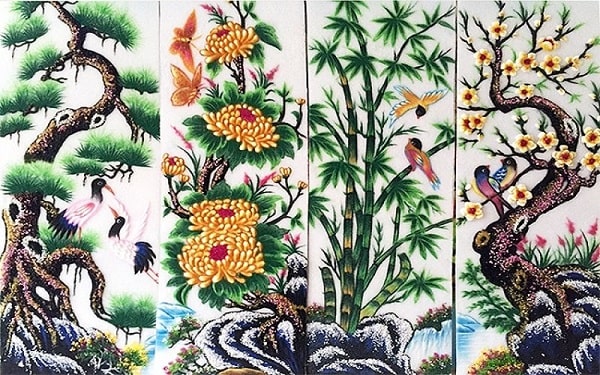
Oil painting Mai Truc Cuc Tung
Before the French colonial period, Vietnamese people still used Han Nom characters to write Vietnamese, the way to write in rows is from right to left, so the four seasons paintings are also arranged from right to left as "Mai-Truc-Cuc-Tung" (corresponding to the order of the four seasons Spring-Summer-Autumn-Winter). Nowadays, due to the break in ancient culture because Han Nom characters are no longer popular, Vietnamese people now write in Latin from left to right, the position of the plants in the four seasons paintings remains the same, but is often read backwards as "Tung-Cuc-Truc-Mai" (and the corresponding season is also reversed as "Dong-Thu-Ha-Xuan").
In China, the Four Gentlemen usually include Orchid (spring), Lotus (summer), Chrysanthemum (autumn) and Apricot (winter).
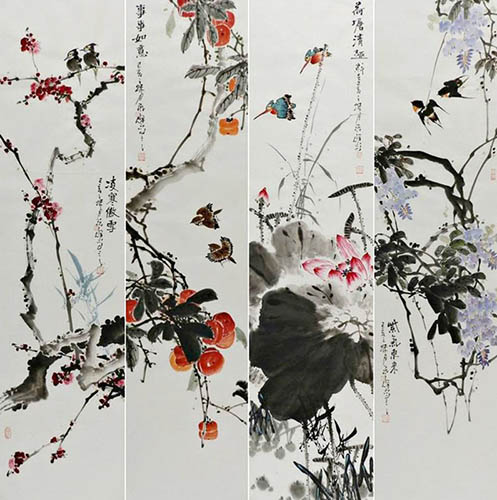
Four Noble Ones Painting: Orchid, Lotus, Apricot, Peach
According to the book "The Spring and Autumn Annals of the Ten Kingdoms", a general of the Southern Tang Dynasty named Guo Chongtao captured many people when he conquered the Shu Kingdom. Among them was Lady Li, whom he forced to be his wife. Lady Li was often sad and depressed, and liked to sit alone under the moon, watching the bamboo branches sway. Feeling emotional, she used a brush and black ink to draw pictures. It is believed that bamboo painting (bamboo painted with black ink) began at that time. However, it is not certain that bamboo painting began with Lady Li. There are also opinions that bamboo painting may have originated in the Later Tang Dynasty, a period when bird and flower paintings developed strongly. Regardless of when it appeared, bamboo painting quickly became a favorite subject of many painters. During the Song Dynasty, bamboo painting reached its peak of development. Many famous painters such as the Song Dynasty had Wen Tong and Su Shi, famous for their bamboo painting, Cui Bai with his plum painting, Zheng Siyou and Zhao Mengjian with his orchid painting, and Zhao Chang and Huang Jubao with their chrysanthemum painting. These works not only show the beauty of bamboo, but also symbolize the qualities of a gentleman. All these famous painters cultivated a land, opened a path for the painting of the following dynasties to develop easily.

Four Gentlemen of Bamboo
During the Yuan Dynasty, bamboo painting continued to develop with many famous painters such as Gao Fangshan, Li Xiozhai, Kha Jiusi, Ni Yunlin, Wu Zhongkui, Gu Dingzhi, Zhao Mengfu, Guan Zhongji, etc. In particular, Li Xiozhai entered a bamboo village, studied all the postures of bamboo, and wrote a book for generations called Bamboo Painting. Kha Jiusi compiled the book Bamboo Painting to study the painting techniques of Song Dynasty bamboo, which can be considered a bedside book for beginners.
During the Ming Dynasty, paintings of plum, orchid, bamboo, and chrysanthemum were extremely popular. There were also many famous painters such as Song Ke, Wang Fu, Xia Chang, Lu Dezhi, etc. The most famous was Xia Chang. His given name was Zhong Zhao, and he began to learn bamboo and stone painting from Wang Fu. Later, he improved his bamboo painting style: the bamboo trunks were straight and proud, with a smoky color, some dark, some light, some withered, extremely magical. At that time, there was a song:
A bamboo fish in the countryside, ten gold bars in the west.
(A bamboo branch from Mr. Ha Xuong's hometown is worth ten gold bars in Tay Luong).
From the Ming Dynasty to the Qing Dynasty, bamboo prints continued to be popular. Many famous painters such as Cao Yi, Wang Yuankai, Wang Daoming, etc. all had excellent bamboo prints.
The painters of the Qing Dynasty still followed the painting methods of the Ming Dynasty. The most famous were Shi Tao and Ba Da Shan Ren, two exiles from the Ming Dynasty. When the Manchus overthrew the Ming Dynasty, Ba Da Shan Ren pretended to be crazy and mute and fled into the mountains to seek refuge. He was a monk for a while and a Taoist priest for a while. Ba Da Shan Ren was of royal lineage, and his name was Zhou Da. His pen name had a profound meaning: Shan Ren means a hermit in the mountains, and when Ba Da was written in cursive, the character "ba" formed two dots overlapping the character "dai", which resembled the character "tieu" (laugh) or "khoc" (cry), expressing a mood that was both funny and sad. He used painting to dispel sadness, and his painting method focused on expressing ideas, simple and bold but lively, containing hidden feelings. The painting methods of Shi Tao and Ba Da Shan Ren were free and unrestrained, not following existing rules, so they could stand alone as a new school of painting. In addition, we can mention some famous painters of the Qing Dynasty such as Trinh Tiep, famous for his orchids and bamboos, Ly Phuong Ung, Kim Nong, Uong Si Than, famous for his plum blossoms. Modern painters such as Trieu Huy Thuc, Ngo Xuong Thac, and Te Ba Thach created many novel strokes that can be called masters of plum blossoms, orchids, bamboo, and chrysanthemums.
The Four Gentlemen are often planted together, creating a harmonious feng shui picture, symbolizing luck, happiness, longevity, and good health. These plants also have the effect of purifying the air, bringing a fresh, clean living space to the homeowner.
Regarding flowers, Chinese literati often assigned each type of flower a certain virtue or literary symbolic meaning, and artists absorbed all of these concepts.
"Chrysanthemum, the flower is a recluse;
Peony, the flower of wealth and nobility;
Lotus, the flower is the gentleman"
(Among flowers, chrysanthemum is the hermit, peony is the rich and lotus is the gentleman.)
- (Song) Zhou Dunyi
It can be seen that, according to the ancients, the Four Gentlemen flower contains very profound meanings. Although it only has symbolic meaning, it is like a bright mirror of personality, which can help people cultivate morality, perfect both mind and body. This is also a layer of the ancient saying "Following nature". People live in accordance with the Way of Heaven and Earth, from which a true social state is formed, the boundary between great men and petty people is clearly drawn, the superior and the inferior are clearly distinguished.
The Four Gentlemen: Plum-Bamboo-Chrysanthemum-Pine
"Bamboo is tall and straight
Bright yellow apricot blossoms
Green pine longevity
Pure white chrysanthemum
Four gentlemen together
Bring luck and happiness."
The ancients called pine, bamboo, and apricot the three friends of the cold season (tuế Hàn tam hữu), because these three types of trees still flourish in the cold season while other types of trees are almost barren and withered. The cold-resistant nature of pine, bamboo, and apricot symbolizes the patience of a gentleman, who is always self-reliant and always cultivates talent and virtue in the face of life's adversities.
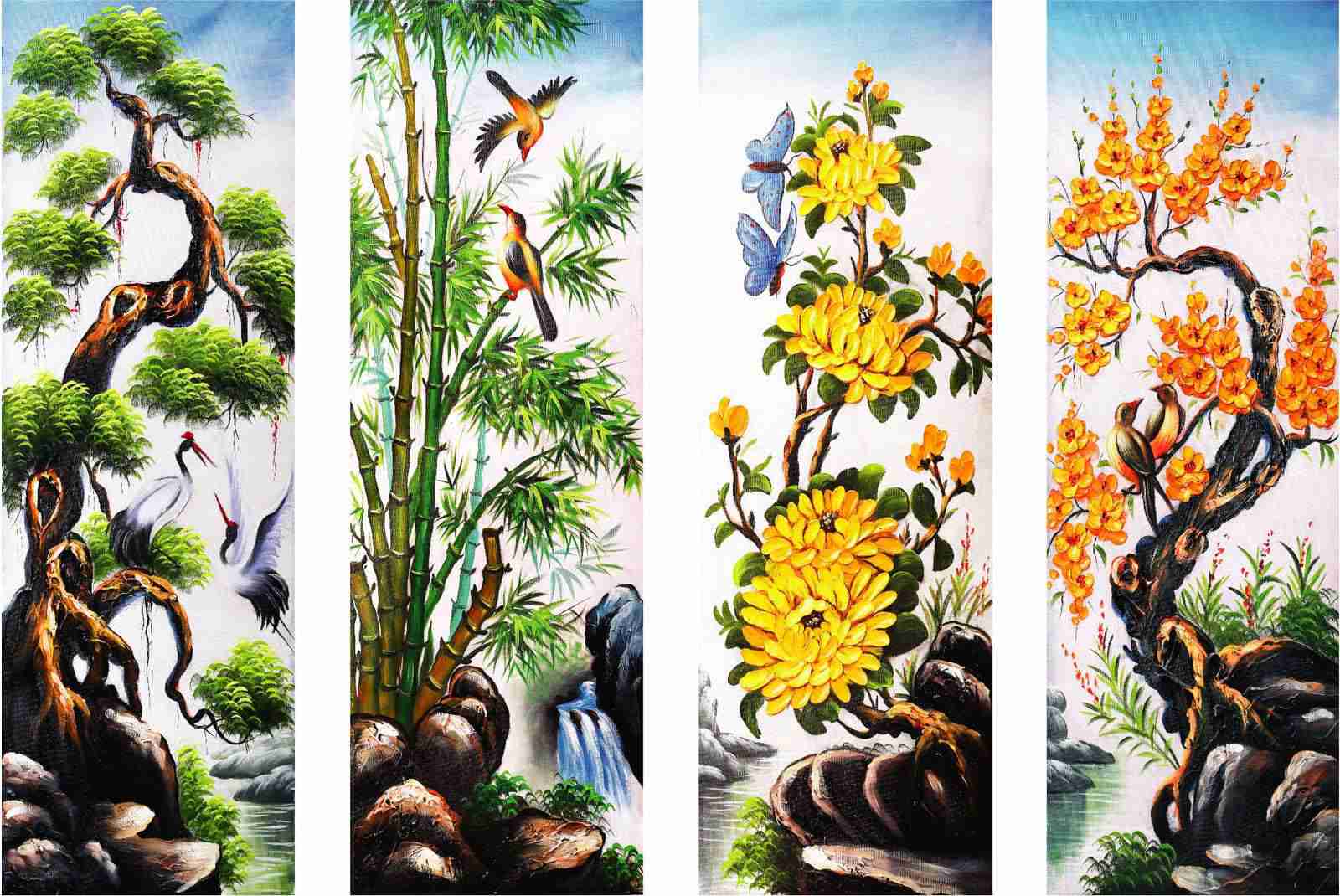
Mai Cuc Truc Tung Painting
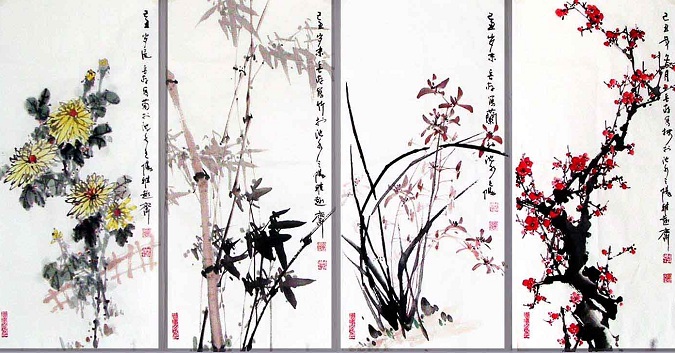
Four gentlemen: Plum, Orchid, Chrysanthemum, Bamboo
In the concept of Eastern people, the four noble plants Mai - Lan - Cuc - Truc are symbols of fullness, stability, eternity, happiness like the four directions, four pillars, four virtues. These four species all have noble personalities. Mai blooms in winter and spring, enduring the cold. Lan is graceful and slender, with a deep fragrance. Truc is upright, heartless, and full of integrity. Cuc endures frost without withering, with the will to challenge nature. Therefore, Eastern literati admired and named these four species the Four Gentlemen. People use the symbols of the four noble plants to decorate their houses not only for decoration but also to pray for luck.
The set of four paintings Mai - Lan - Cuc - Truc represents the rotation of the four seasons Spring - Summer - Autumn - Winter, bringing luck to people, as well as hope and desire for smoothness and prosperity in life. Not stopping there, the set of four gentlemen paintings is also a symbol of the spirit, noble character, and resilience of a gentleman. The set of paintings is often hung in the living room, study room, office, decorating the house and bringing luck and fortune to the owner.
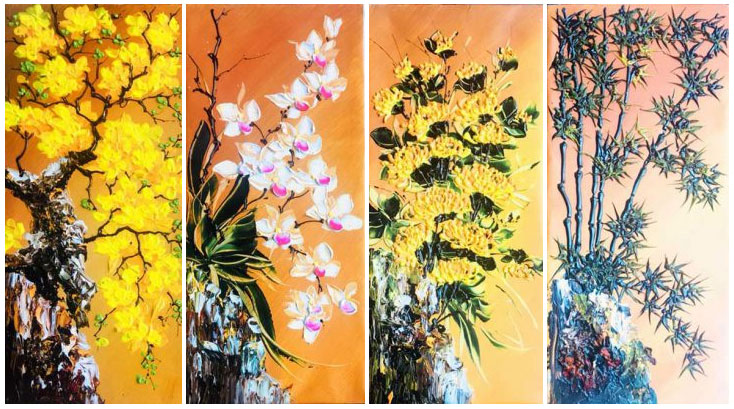
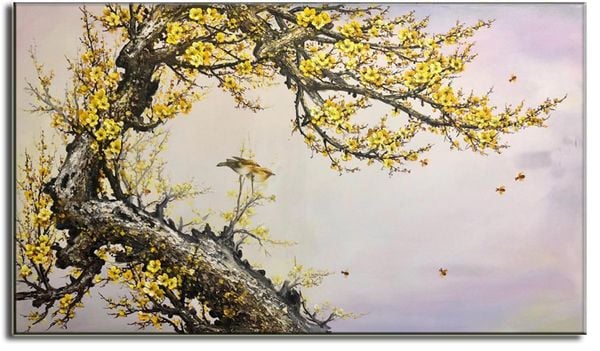
Plum - Peach
In the cold of winter, apricot blossoms endure the cold, blooming earlier than other flowers and it is an early sign of spring, signaling a peaceful and good new year.
Apricot is a flower with tenacious vitality, despite harsh weather, in the cold, it still blooms with strangely brilliant colors. The ancients used the image of the apricot blossom to remind a man not to be afraid of difficulties, not to be afraid of hardship, in hardship to hone his will. Resilience to overcome difficulties is the necessary temperament of a great man.
Ten Wheels of Ancient Swordplay
All my life I bow down to the plum blossoms…”
(Ten years of communication to find the treasure sword
A life of bowing only to apricot blossoms)(Ten years of traveling in the shallows to find the ancient sword, a lifetime of only knowing how to bow to Hoa Mai)
- Cao Ba Quat (1809-1855) -
Although not majestic or imposing, the apricot blossom is simple, gentle and generous; it implies that a gentleman who wants to accomplish great things must first be simple, modest, easy on others and difficult on himself, be generous and tolerant with others, and carefully consider his words and actions.
Apricot is a flower symbolizing purity, integrity and modesty, meaning luck and happiness. The fragrance of apricot is gentle like the heart of a gentleman with a pure soul, a mind like a vase of pure water. Apricot is called the flower of five blessings.
“Apricot blossom brings five blessings: happiness, luck, longevity, success, and peace.”
During the Song Dynasty, there was a hermit named Lam Bo who loved plum blossoms so much that he did not need a wife or children, but only devoted himself to growing plum blossoms and raising cranes. People gave him the saying "mai the hac tu" (plum blossoms are his wife, cranes are his children).
The famous plum painters were Vuong Mien and Tran Hien Chuong. Vuong Mien, whose real name was Nguyen Chuong, was famous for his graceful and elegant plum paintings at that time. Vuong Mien and Ha Xuong were a pair of famous painters; one was a plum painter, the other was a bamboo painter.
Peach blossoms originated in China, then were introduced to Vietnam and other East Asian countries. There are many types of peach blossoms, the most popular being the pink peach blossom, the blue peach blossom and the white peach blossom. Peach blossoms are considered the flower of spring, symbolizing new beginnings, hope and faith. Peach blossoms are also a symbol of love, beauty and luck. Peach blossoms are often grown in gardens, indoors or decorated in vases during the Lunar New Year, creating a joyful, warm living space, bringing luck and happiness to the homeowner.

(Photo: Adobe Stock/Epochtimes)
Lan
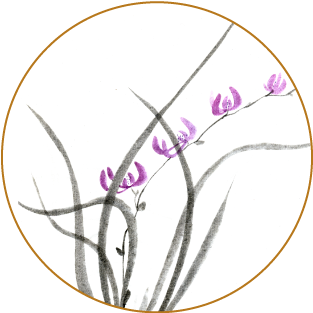
Orchid is known as the world's number one fragrance.
Orchid is a fragrant herb. The ancients believed that orchids are the ancestors of fragrance, possessing a noble, regal, and proud scent. The ancients valued orchids so much that they gave them many names such as: Duliangxiang, Thuyxiang, Huongthuylan, Huongthao, Nulan, Chilan... These nicknames partly describe the fragrance and temperament of orchids. Orchids are graceful, slender, and have a deep fragrance. Using their own fragrance to praise themselves without seeking external glory is one of the common images in Chinese paintings.
The Chinese discovered orchids a long time ago, and the hobby of growing and playing with flowers has at least 2,000 years of history, starting from the Han Dynasty, through the Southern and Northern Dynasties, and by the Tang Dynasty, orchid growing and playing began to become popular. During the Ming Dynasty, the famous physician Li Shizhen wrote in the book “Compendium of Materia Medica”, guiding the experience of growing and playing with orchids, so at this time orchid players were also more sophisticated. During the Qing Dynasty, this hobby was still passed down. The ancients believed that growing and caring for orchids was a process of self-cultivation, cultivating orchids was cultivating the qualities and personality of a gentleman.
The ancients believed that a gentleman should use his heart and virtue as his own fragrance, like an orchid, simple and pure but with a spreading fragrance. People use their heart and virtue as their own fragrance to equip themselves, not seeking external glory, not embellishing or faking. The ancients said:
“Orchids grow in the deep forest, but do not lose their fragrance because of external circumstances. A gentleman cultivates morality and does not change his character because of poverty.”
Enjoying the beauty and gentle fragrance of wild orchids has always been one of the top hobbies of ancient scholars. The Korean poet Lee Byeong-gi, also known as Garam (Gia Lam) (1891-1968), was a lover of orchids. He once said that if one had a few books, a bottle of wine, and a pot of orchids, no one would be jealous of high-ranking officials. In his ancient poem Sijo about orchids, the poet Lee Byeong-gi wrote:
Leaves are slender, look hard but soft
Big branch, purple heart, pure white flowers
Dew drops glisten, hanging on each leaf joint
Confucius traveled all over the world, persuading kings to use his teachings to govern the country. On the way, he saw orchids among the weeds. He immediately thought of himself and compared his status to orchids: Orchids are originally the scent of royalty, but he did not expect that today he would have to be a fellow traveler among the weeds. He put down his zither and played a very sympathetic piece of music, which later became very famous in the history of Chinese music. The story of Confucius directly comparing himself to orchids became the earliest example of the encounter and connection between orchids and lilies and gentlemen.
More than two thousand years ago, the poet Qu Yuan even compared orchids to beauties:
"Oh autumn orchids, so smooth, purple stems and green leaves. The house is full of beauties, only with me they flirt." - Khuat Nguyen
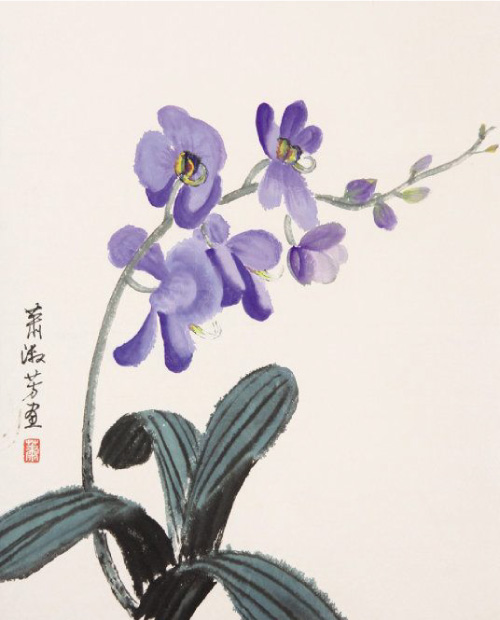
Painting "Orchid". (Photo: Pinterest)
Chrysanthemum
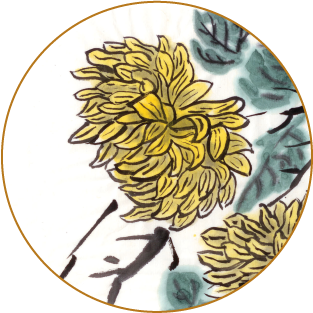
Chrysanthemum is known as the Royal Flower of China.
The ancients valued the color yellow, they believed that yellow was the color of prosperity and good fortune. Therefore, the yellow chrysanthemum was called: Chinese chrysanthemum. Chrysanthemums were grown more than 3,000 years ago. At that time, chrysanthemums were mainly yellow chrysanthemums, so they were called golden chrysanthemums. During the Jin Dynasty, white chrysanthemums appeared.
Chrysanthemum is a flower that symbolizes nobility, elegance, luck and longevity. Chrysanthemum has a different characteristic from other flowers, which is that it blooms very late. When all the flowers are competing to show off their beauty in spring, chrysanthemum blooms in autumn. Chrysanthemum does not want to compete with the flowers in spring, it would rather stay in the cold and windy season, with a single branch standing alone. A single flower, a single flower, showing off its beauty and fragrance. The quality of chrysanthemum is to endure loneliness, dare to be arrogant, proud, despise the world, dare to bloom in a season where no flowers bloom. Dare to do what others do not dare to do; dare to think what no one in the world has thought of. This is the manifestation of the spirit and mettle of a gentleman with his head in the sky and his feet on the ground.
In the cold autumn weather, all trees wither, but chrysanthemums bloom and bloom, proving that they contain the true energy of heaven and earth. The meaning is that the character of a hero must take virtue as the core of his true character. Only then can he create a unique nobility.
The concept of chrysanthemum as a recluse probably originated from Tao Qian, also known as Tao Yuanming of the Jin Dynasty, a great poet who was tired of being a humble official, retired from office, enjoyed the countryside, was happy with poverty, liked to drink wine, play with chrysanthemums and travel around. People praised him as a pure recluse. This recluse drank wine and watched chrysanthemums to forget the hustle and bustle of life, so chrysanthemums are also a symbol of a gentleman who is a recluse.
"The chrysanthemum in the winter leaves, and I can see the South Mountain"
(Picking chrysanthemums under the winter fence, looking at the southern mountains in a poetic way).
- Drinking Wine - (Jin) Tao Qian
This hermit drank wine and admired chrysanthemums to forget the hustle and bustle of life, so chrysanthemums are also a symbol of a gentleman who hides from the world. Tao Qian once said:
"The autumn chrysanthemums are all colorful, the dew on the flowers is dazzling, forgetting all worries, far away from me, the world's feelings"
(Autumn chrysanthemums have beauty, revealing their elegance, making us forget sadness and stay away from worldly affairs)
(Jin) Tao Qian

Painting "Chrysanthemum". (Photo: Pinterest)
Bamboo
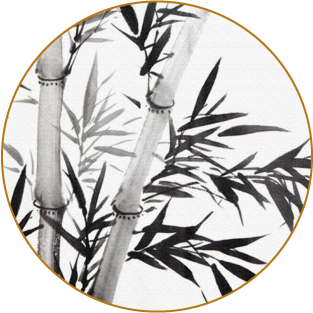
The upright and proud bamboo symbolizes integrity and integrity, and can stand firm against storms without falling. Bamboo is a plant with strong vitality, growing tall and straight, symbolizing resilience and indomitability. Bamboo is also a symbol of the noble and elegant temperament of a gentleman.
Bamboo is a symbol of a gentleman because this plant is hard but still soft, meaning that a person who knows how to use both hardness and softness is a talented person, can fall but not break, the hollow bamboo is like a peaceful and carefree spirit, does not see other people's faults, only sees one's own faults, is not infatuated with power, material things, is simple and noble, and excludes lust.
And like the temperament of a gentleman, bamboo and bamboo flowers would rather die standing than drooping like other flowers. This is the temperament: it is better to die with honor than live in disgrace. It is a rare image between heaven and earth.
Bamboo in Chinese painting is not only an artistic subject, but also a cultural symbol. Bamboo symbolizes the noble qualities of a gentleman, such as steadfastness, indomitability, and noble character. Bamboo paintings by famous Chinese painters have contributed to preserving and promoting the good spiritual values of Chinese culture.
The green mountains and pine forests are not allowed to grow,
Establish the foundation in the rock.
The ten thousand demons are all strong and respectful,
East, west, south and north winds.- Bamboo stone -
Hold on to the green mountain and never let go,
The roots grow firmly on the far wall.
Thousands of dams and thousands of collisions remain strong,
The wind blew all around.- Bamboo Stone -
One of the people who loved bamboo is Su Shi. He said: "I would rather eat without meat than live without bamboo." This shows how highly regarded the status of bamboo was and how all literati and scholars considered bamboo an indispensable companion.
A scholar named Won Cheon-seok who lived during the late Goryeo and early Joseon dynasties in Korea in the 15th century refused the invitation of the Joseon court to remain loyal to the Goryeo dynasty. He left behind an ancient poem Sijo which reads:
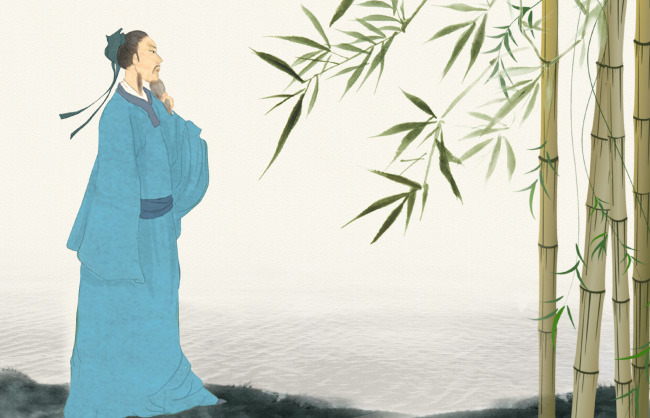
Bamboo is a symbol of a gentleman. (Photo: Adobe Stock/Epochtimes)
Pine
Pine is a giant tree with a strong and enduring vitality, symbolizing longevity and good health. Pine is also a symbol of the dignified and upright temperament of a gentleman.
Application Form
In the four seasons, peony symbolizes winter.
In Eastern countries, peonies are known as the "queen of flowers" and are a flower of wealth.
Peonies have a proud, splendid beauty, both luxurious, noble and elegant, powerful, both proud and dignified but with a passionate and spreading attraction, both feminine and graceful but strong and vibrant. It is definitely a flower with a beauty that shows the noble temperament of the owner. The rich love the splendid and brilliant colors of peonies. Peonies are rare flowers, only the rich and noble play with this flower. Therefore, peonies are a symbol of wealth, prosperity and prosperity.
"The world's only true flower, peony"
(Only peony is worthy of being the real flower in the world).
- Ouyang Xiu -
According to legend, the story of peonies originated from the story of maternal love. A mother gave birth to 10 children. When the village was occupied, their father was killed. Later, all 10 children joined the army to fight the enemy in the mountains, the eldest son was the commander. This army drove the enemy crazy. The enemy captured the mother and threatened and bribed her to ask her children to surrender. She refused to follow their words, wholeheartedly asking her children not to betray the country. Her children were also motivated to fight because of that sentence. The enemy was afraid and covered their mouths, poured pine resin and caulking resin on the mother's head and burned her to death. When the villagers arrived, they found the mother's heart still intact and burning. They buried her right on top of the hill. When spring came, a tree grew from that grave, blooming red flowers with the shape of a flame like the mother's heart. And from that day, a flower called Peony was born.
According to records, peonies have been present in China for more than 2000 years. Initially, peonies were grown in China for medicinal purposes, however, during the Sui Dynasty (581 – 618), they were first grown in flower gardens, and later became an ornamental plant.
The peony was once strictly protected in the Shangyuan Garden during the Tang Dynasty. Later, during the Song Dynasty, the flower flourished throughout China, and the Song capital of Luoyang became the center of peony cultivation.
In each country, this flower has different symbolic meanings. In China as well as Vietnam, peony is considered the flower of royalty. In Japan, peony flower symbolizes fidelity, happy marriage, and many children and grandchildren.
According to the ancients, peony flowers are considered a symbol of peace, meaning as a talisman. In addition, this type of flower is also used in opening ceremonies, New Year to wish the homeowner a smooth career, full of wealth. Brings wealth, glorious career, full happiness. In feng shui, the peony symbol is often combined with the image of a peacock. Representing nobility, opening the path to fame, royal life, wealth and prosperity.
The peony is very important to Chinese culture. This magnificent flower is an official symbol of China and plays an important role in many major national and religious holidays. It is the flower with the longest history as a symbol of China. Oriental culture is associated with honor, respect, social status and royalty in feudal society. The beauty of the peony is associated with the beauty of Yang Guifei - one of the four great beauties of ancient China. Considered the most beautiful flower, however, when meeting Yang Guifei walking in the Shangyuan garden, the peony felt that it could not compare to her beauty and shyly folded its petals.
Chrysanthemum, the flower of seclusion; peony, the flower of wealth; lotus, the flower of gentleman.
(Among flowers, chrysanthemum is the hermit, peony is the rich and lotus is the gentleman.
(Song) Zhou Dunyi

Paintings and screens depicting large, noble and magnificent peonies
According to traditional oriental medicine, peony is used as a medicinal herb to purify the body of bad things. In addition, it is believed that the essence extracted from peony seeds and roots can cure insomnia or sleeplessness, and eliminate nightmares.
Traditional Chinese medicine practitioners also use it to treat abdominal pain and urinary tract problems. Recent scientific studies have shown that peony has properties that are suitable for cell therapy, anti-infective, and inflammatory reactions without direct cause.
Lotus
Lotus symbolizes summer.
The lotus flower is the essence of a gentleman. The lotus flower grows from the mud but still has a fragrant scent, close to the mud but not tainted by the mud. The lotus flower is the essence of the mud, stretching out its petals to welcome the dawn, then following the wind, its gentle fragrance, simple, elegant, pure, like a spread of a life full of love, to ease the tension in the midst of a thorny life, helping people to erase all worries to calmly enjoy happiness. Even though life is filthy, human relationships are warm and cold, a gentleman still maintains his integrity, noble, ethereal, fragrant and pure like that lotus flower.
Dig
Not only flowers, but fruits also have symbolic meanings.
Peaches symbolize longevity; for example, the painting "Peach offering a thousand years of spring" depicts an old man holding a peach.
Pomegranate symbolizes having many children; for example, the painting "Pomegranate gives birth to a hundred children" depicts an old man holding a half-opened pomegranate, showing the seeds.
Buddha's hand fruit symbolizes fortune; for example, a painting of a Buddha's hand fruit (fortune) with a peach (longevity)
Pomegranate (many children) means: much happiness, much longevity, many sons.
Tangerines symbolize goodness. Even in daily life, people like to give each other tangerines.

Not only flowers, but fruits also have symbolic meanings. For example, peaches symbolize longevity; for example, the painting "Peach offering a thousand years of spring" depicts an old man holding a peach. Pomegranate symbolizes having many children; for example, the painting "Pomegranate opening to give birth to a hundred children" depicts an old man holding a peeled pomegranate, showing the seeds. Buddha's hand fruit symbolizes fortune; for example, a painting depicting Buddha's hand fruit (fortune) with peaches (longevity) and pomegranates (many children) implies: much fortune, much longevity, much sons. Tangerines symbolize goodness (good luck). Even in daily life, people like to give each other tangerines.
0 comments