
Heart like brocade, mouth like embroidery
The art of embroidery on clothing has brought fashion into an 'endless world' of creativity. Besides fashion, embroidery also carries cultural significance specific to each country, each dynasty, each period, each brand.
Today, let's go back a little bit to the old days, when embroidery was born, and the ups and downs that kept this quintessential art form always holding a certain position on the world art map.
Using cloth to make paper, using thread to make ink, using needles to make pens - hand embroidery industry

Traditional Vietnamese hand embroidery
Ancestor Le Cong Hanh
Vietnamese hand embroidery art appeared in the mid-17th century, inherited from China.
Before the 18th century, Vietnamese people had known the craft of embroidery and parasol making for a long time. Historical records recorded that during the Tran Dynasty, kings and mandarins were accustomed to using embroidery and parasols. In 1289, King Tran sent the Yuan King a red silk cushion embroidered with gold thread and a brocade carpet bordered with silk. In January of the year Quy Ty (1293), Tran Phu, a member of the Yuan Dynasty's delegation to Dai Viet, commented: "Regarding the ranks of Dai Viet mandarins, who is high or low, just look at the parasols to distinguish. If they are mandarins or generals, they carry three green parasols, if they are of lower rank, they carry two parasols, then one parasol. As for purple parasols, only those in the royal family are allowed to use them."
However, the embroidery craft in Dai Viet before the 18th century was still simple, revolving around five-color threads and gold thread, making items for the king, mandarins, and pagodas (embroidering hats, mandarins, court costumes, ceremonial gates, flags, etc.). In an ancient tomb excavated in Van Cat, Nam Ha, dating back to around the 18th century, people found: next to the fan, there was a betel bag made of brocade embroidered with gold thread, a tobacco bag also made of brocade embroidered with gold thread.
According to records, the founder of Vietnamese embroidery was Le Cong Hanh (January 18, 1606 - June 12, 1661), who lived during the Later Le Dynasty. His real name was Tran Quoc Khai, from Thuong Phuc district, Thuong Tin prefecture, Son Nam town (now Quat Dong village, Quat Dong commune, Thuong Tin district, Hanoi). According to legend, since childhood he was known for his love of learning and good writing. When he grew up, he passed the doctoral exam (during the reign of King Le Than Tong or Le Chan Tong). After becoming an official, he was appointed by the court to various positions from the border district to the royal court, gradually promoted to the rank of Minister, and was once sent as an envoy to the Ming Dynasty.
In the year of Binh Tuat (1646), he was sent to the Ming Dynasty as an envoy. To test the talent of the Southern envoy, the Ming army did not take him by the main road but took a shortcut. When they reached a mountainous and valley area, they ran out of food, so he ordered bamboo to be cut down and woven into traps, and ordered his soldiers to go down to the stream to catch fish and go up to the forest to find fruit. Thanks to that, our embassy passed the mountainous and forested area in good health. After completing the diplomatic mission, the Ming King wanted to test the envoy's talent once more, so he ordered the construction of a towering tower and invited him to come up to play. As soon as Tran Quoc Khai arrived, the Ming army on the ground removed the ladder. He stayed upstairs for a whole day, but no one brought him food or water. Looking around, he only saw an altar. In front of the altar, there were two beautiful green and red parasols; above hung a curtain with embroidered dragons and phoenixes and three words "Phật tại tâm" (Buddha in the heart). The Maitreya Buddha, with a big belly and painted black, was placed in the middle of the altar. At the foot of the altar, there was a large jar of water for offerings and in the corner stood two bamboo sticks and a knife, with absolutely no food. A day passed, his stomach was hungry but there was no rice to eat, only a jar of water, he thought that if there was water to drink, there must be food to eat. Turning to look at the statue, curious to see what it was made of, he used his fingernail to scratch the back of the Buddha and found a small piece that popped out, and when he crushed it with his hand it crumbled into powder. He brought it to his mouth to taste and found it sweet, it turned out the statue was made of rice cake flour (some documents say the statue was made of green tea powder). From then on, he gradually broke the Buddha statue into pieces to eat twice a day. When he was bored, Tran Quoc Khai split bamboo, whittled strips, carefully observed how to make an umbrella and absorbed the details. When he knew how to make an umbrella, he lowered the curtain, removed the gold and silver threads to see how to embroider, then used the same threads to embroider again. When he finished, he looked at the embroidered letters and saw that they were exactly the same as before. After finishing the statue and drinking almost all the water, Tran Quoc Khai found a way to get down. In the afternoon, he sat watching the sky and clouds, seeing bats spreading their wings and flying back and forth like leaves. He thought of the two parasols on the upper floor, then hugged the parasols and jumped down to the ground safely. Before the flexible response of the Dai Viet envoys, the Ming court was extremely impressed and held a big banquet to send the envoys back to their country.
With his intelligence and wise diplomatic behavior, after returning to the country, Tran Quoc Khai was awarded a title, promoted to the position of Minister of Public Works, and changed his surname to Le, so he had another name, Le Cong Hanh.
After returning home, he passed on his craft to his children and villagers, then expanded it to other provinces, including Bac Ninh and Hung Yen. Since then, the embroidery craft in Quat Dong has become known to many people here, gradually becoming a traditional craft of the whole region. In addition, he also taught people how to make parasols. The embroidery and parasol making craft has become increasingly developed. His descendants continue to develop this art, making Quat Dong village a center of traditional embroidery art.
The memorial service for the founder of the embroidery craft in Vietnam is usually held on his annual death anniversary. In Hue alone, the memorial service for the founder of the embroidery craft, Le Cong Hanh, at Pho Cam Tu - Hue, is held on the 22nd day of the first lunar month every year and the 4th day of the sixth lunar month is the founder's anniversary.

Artisan
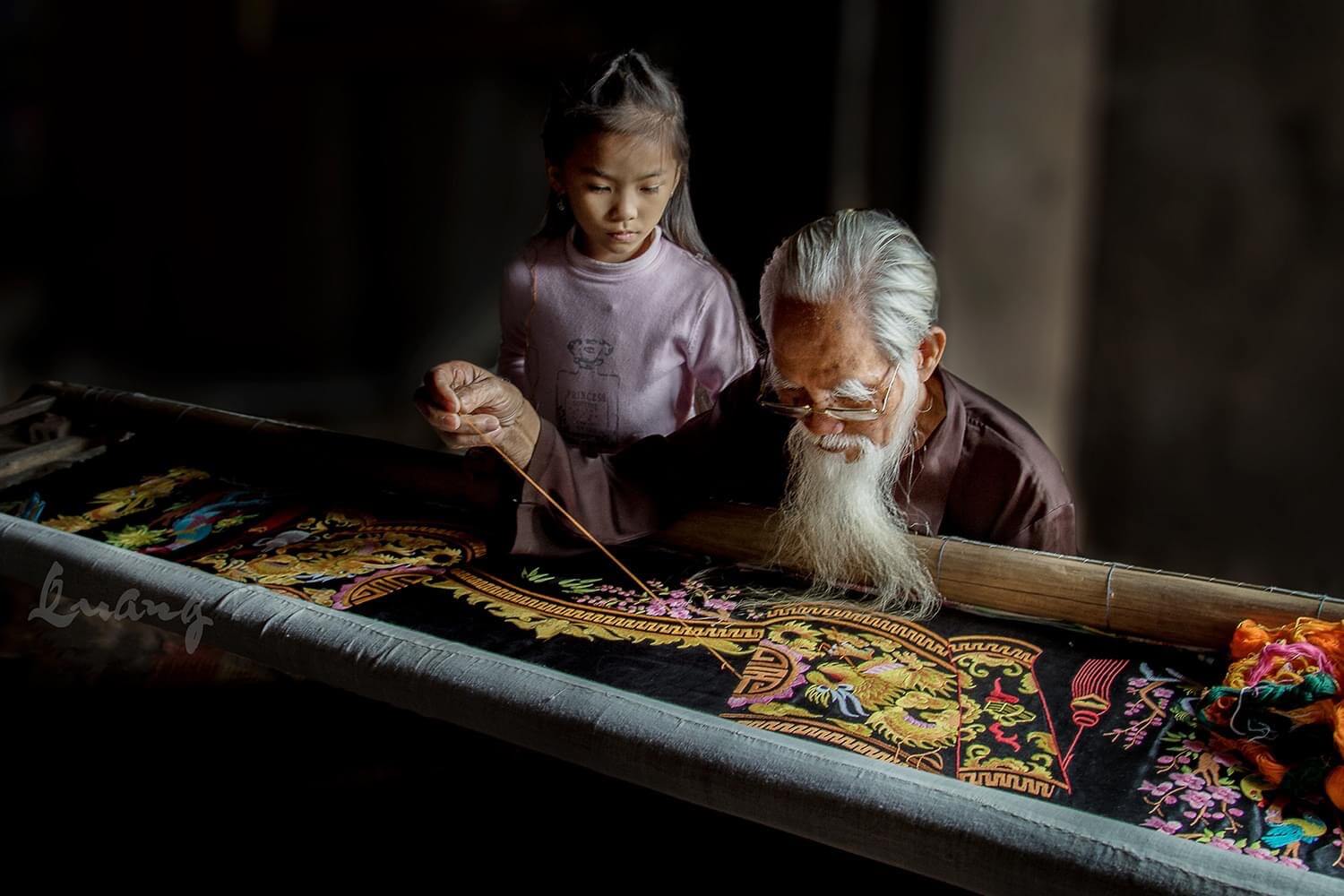
Embroidery is not only a skill that shows the perfect beauty in each stitch, but also a form of moral cultivation, understanding the inner meaning. A true artist must use his heart to achieve purity, a pure heart, a peaceful soul, skillfully using both his hands and heart to create perfect works.
Until the feudal period, hand embroidery was one of the professions serving the King and the Aristocrats. Embroidery products were completed by fabric threads created by the creative efforts of Vietnamese artisans. The threads at that time were dyed by hand with completely natural materials such as brown tubers, indigo plants, areca bark, water lily, vông leaves, whetstone, pagoda flowers... making foreigners admire and comment that:
"Looking at the dyed colors of the workers, it seems very simple, but when finished, it has a very strange color palette that seems like it was created by magic."
During that period, embroidery was often done by Vietnamese women. According to Confucianism, a girl must perfect the four virtues: "Cong, Dung, Ngon, Hanh":
"Men read books and recite poems,
Girls do needlework and embroidery.
.jpg)
Craft village
Hue Hand Embroidery - Magical Delicacy
During the feudal period, the majority of women in the country knew how to embroider, but the concentration and professionalism for a long time was in Hue. When the Nguyen Dynasty was established in the ancient capital of Hue, Mrs. Hoang Thi Cuc, mother of King Bao Dai, together with Queen Nam Phuong combined the advantages of European embroidery techniques with the quintessence of Asian embroidery art to turn it into the embroidery art of the Royal Court, associated with the gentle, delicate, meticulous characteristics of Hue women. Their products were not only decorative, but also symbols of prosperity and civilization.
Many places have passed down to their descendants strange crafts such as drawing with thread to make lotus and marigolds bloom on silk, to make butterflies flutter on the surface of clear water. Annamese embroiderers are more skillful than Chinese embroiderers in terms of needlework and color mixing..." - Gabrielle, a French scholar specializing in East Asian culture.
"Vietnamese embroiderers are very skillful in distributing colors on silk, to create harmonious embroidered pictures that are not too harsh." - Hocquard, author of a book about embroidery in the late 19th century, commented.

XQ Embroidery - High Art
In the early 90s, Vietnamese silk embroidery gradually reached its artistic peak when the XQ company was established. The artist couple, artisan Vo Van Quan and Hoang Thi Xuan, charted a new direction for the profession by combining the characteristics of painting with the quintessence of traditional embroidery techniques that Ms. Hoang Thi Xuan - who comes from a family of Hue origin - inherited and created.
The authenticity in every detail of XQ embroidery paintings and the beauty created from meticulous hand-embroidered lines have made this line of paintings famous not only domestically, but also loved abroad, especially for customers who love unique handmade products rich in artistic aesthetics.
Since its establishment in 1996, XQ has set a goal of bringing traditional embroidery to a new level, a mission that XQ has impressively fulfilled.
From traditional floral motifs to landscapes or detailed portraits, XQ's embroidery artisans bring authenticity to their work with soft embroidery lines and the patience and perseverance required to be honed over time.


Oddity Central believes that XQ embroidery paintings can be considered a form of visual art where words are often not enough to fully describe the beauty of the work.
However, up to now, the number of traditional embroidery villages is not much. The main reason is the strong development of industrial products. However, traditional art villages are still trying to maintain their embroidery profession such as Thang Loi, Le Loi, Nguyen Trai, Phu Xuyen, Co Dong, Dong Cuu, Binh Lang (Hanoi); Minh Lang (Thai Binh), Thanh Ha (Ha Nam), Kim Long, Thuan Loc (Hue), Bao Loc (Lam Dong) ...
- Thuong Tin Embroidery Village (Hanoi): from the cradle of Quat Dong commune, the embroidery profession has spread to neighboring communes: Dong Cuu, Thang Loi. For generations, in addition to farming time, people here have been diligently working on their looms. Many girls are taught by their grandmothers and mothers how to hold an embroidery needle even before they can read. Nowadays, thanks to technology, the embroidery profession has been supported to some extent. For example, embroidery threads, which were previously limited in color, can now be dyed more easily.
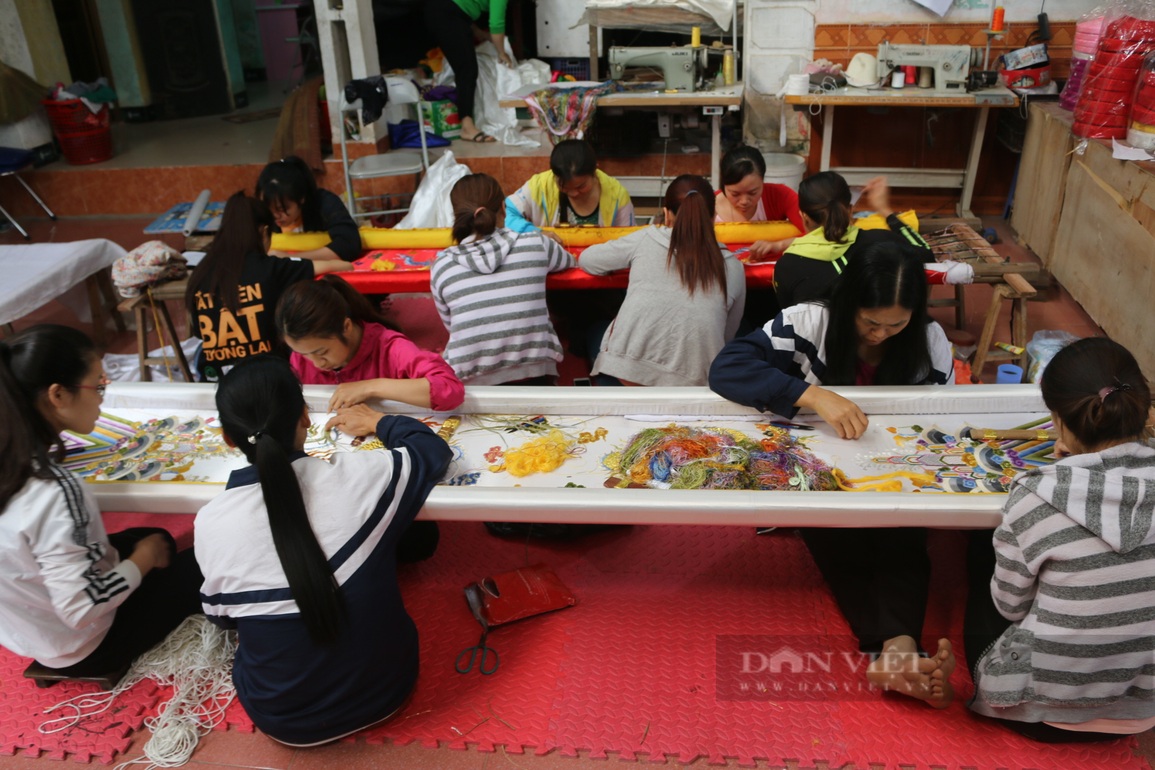
- Van Lam embroidery village: located next to Tam Coc-Bich Dong tourist area, Ninh Hai commune, Hoa Lu district. Along both sides of the road to the village are shops selling products such as handkerchiefs, shirts, paintings, all meticulously embroidered by artisans with beautiful, eye-catching images. Among them, the most unique are the embroidered paintings, mainly paintings of landscapes, homeland, and country. According to the village's elderly artisans, the lace embroidery profession in Van Lam village is over 700 years old. Legend has it that the embroidery profession appeared when King Tran defeated the Yuan-Mongol invaders, and the villagers were taught how to raise silkworms, weave, and embroider by Mrs. Tran Thi Dung. In the 20th century, in the village, two brothers of the Dinh family went to Hanoi to learn the French lace embroidery and friezing profession and taught it to the villagers. Since then, Van Lam's hand-embroidered products have developed strongly. Each work is imbued with humanity, expressing the soul of the countryside, arousing in the viewer a love for the beautiful country.
- Mong - My A : My A with solid, spacious houses, concrete roads, life gradually changes but the traditional embroidery art is still preserved by the skillful hands of Mong women who consider embroidery as a duty to take care of food and clothing for the family. From a young age, Mong girls are taught by their grandmothers and mothers to embroider on linen cloth, girls of marriageable age can embroider for themselves colorful, beautiful dresses to bring to their husband's house. Holding in your hands the dresses, shirts, belts... embroidered with brilliant five-color wool, you can see the meticulousness and creativity of the skillful hands who are still attached to the fields all year round. Each pattern is rustic, closely linked to the life and spirit of the Mong people. The main motifs are squares, crosses, nails, diamonds, triangles, circles, single swirls, double swirls, sawtooth... Inside are five-pointed stars, squash blossoms, plum blossoms, peach blossoms... Some special patterns are often used to express their own meanings such as the snail embroidery which means kindness and peace; squash blossoms, star anise are used to embroider on wedding dresses, belts given to lovers... Or the image simulating the flax spinning wheel - one of the stages of the flax weaving technique is often embroidered on dresses and some souvenirs such as scarves, bags, wallets... When embroidering, there is no specific pattern but only based on experience and the way to calculate each needle and thread, the size on the entire piece of fabric, if there is just one wrong needle stitch, it must be removed and redone. When completed, the entire pattern on the fabric must be even in every detail from the needle and thread to the harmonious color scheme. That color combination secret has been practiced and created by generations of Mong people for generations, and the patterns have also been preserved through memory and passed down from generation to generation.
“Embroidery takes place all year round, and can be done during the off-season, during lunch breaks in the fields, or in the evenings. Embroidery is not simply about creating costumes for daily use, but also contains the traditional culture of the Mong people. Every Mong woman must have a few hand-embroidered dresses with five-color embroidery, worn on important events of the year such as when going to festivals, going to the market, especially during Tet.” - Ms. Sung Thi Mai (30 years old, Sub-zone 2, My A area, Tan Son district) said.

Mong people preserve traditional hand embroidery art - Photo: Phu Tho emagazine newspaper.
Conservation and Renaissance
Looking back at history, Vietnamese embroidery artisans have always been highly appreciated for their ability to combine colors and meticulousness in embroidering on fabric, creating harmonious and soft works. The needle and thread lines seem to jump up and down the fabric, creating vivid and delicate images. This has created a class for Vietnamese hand-embroidered products in the international market.
In traditional motifs, such as blooming flowers, dragons and phoenixes on the wall, flowers, birds, fish and insects, it implies the best wishes for relatives and friends. Through the quintessence of the distillation, the embroidery skills and methods have been passed down to this day. Through the needle and thread lines that seem to fly up and down the fabric, the artisan vividly depicts images around life, from simple flowers and animals, to people, birds, flowers and leaves skillfully blending together in a skillful and lively way, expressing people's thoughts and feelings, enriching spiritual life, making human life more complete.
The art of hand embroidery in Vietnam has undergone a transformation with the emergence of traditional embroidery and modern hand embroidery.
- Traditional hand embroidery: focuses on landscape, nature and portrait paintings, small embroidery stitches, shiny silk thread or thin silk thread on silk and linen fabric, requiring meticulousness and a long production time. Traditional embroidery has a smooth, gentle color transition, creating softness and slenderness of the details. In addition to embroidery on flat surfaces, traditional embroidery is also used to create extremely sophisticated 3D flower works on canvas.
With meticulousness and diligence in every needle and thread, hand embroidery artisans not only create beautiful works but also demonstrate patience and passion for the art of embroidery. Hand embroidery is not only a way to decorate clothes and accessories, but also an activity that effectively helps relax the mind.
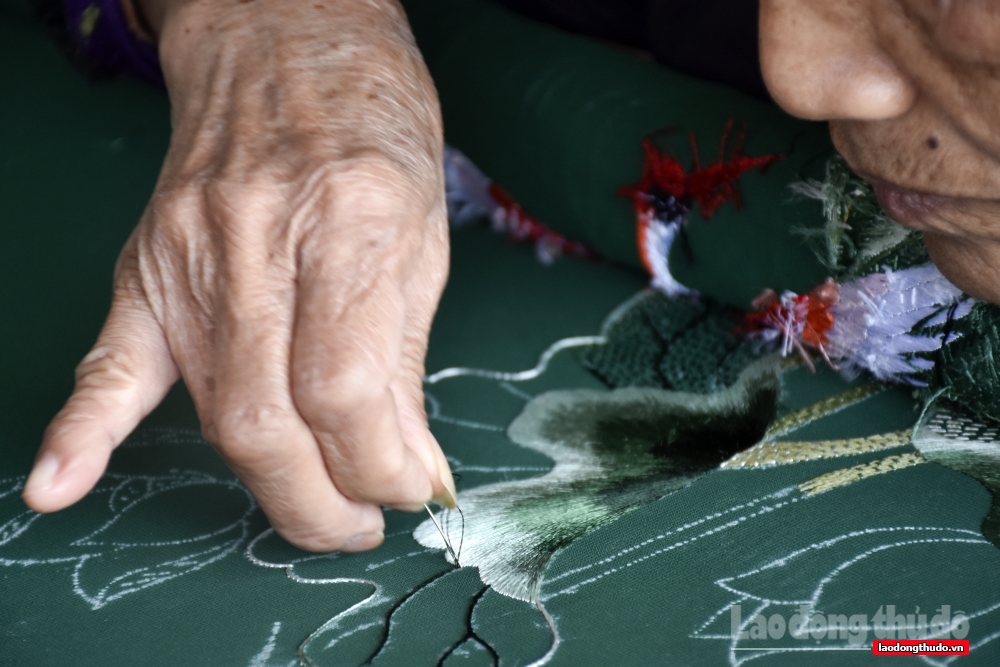
- Modern hand embroidery: Modern hand embroidery, also known as artistic hand embroidery, is a combination of traditional embroidery techniques, stitches and the use of modern motifs, modern color combinations along with the use of new threads on new materials. With modern hand embroidery, embroidery themes range from nature, portraits, festivals, animals..., with many different styles such as contemporary, minimalist, Parisian, Mexican. Modern hand embroidery is also applied on materials such as linen, jeans, khaki, canvas, leather, cardboard, bringing different effects. Modern hand embroidery focuses on the creativity and personalization of the artisan, opening up many new possibilities such as 3D embroidery, punch needle embroidery, crochet embroidery, bringing unique and artistic products. Modern hand embroidery is a new embroidery technique that requires the embroiderer to have a fresh look, bringing "uniqueness" to his works to create a trendy, artistic product.
Modern hand embroidery artisans are not simply people who do embroidery work, but also creative artists, bringing "uniqueness" to each work, creating hand embroidery products that are not only decorative but also artistic.
Attentive and meticulous with each needle and thread, Ms. Huynh Thi Trang, 27 years old, Hue City happily chatted: “This modern embroidery art seems simple, but to have a beautiful, finished product, it depends on the skill and meticulousness in each embroidery stitch. Above all, to make a hand-embroidered product, the embroiderer needs to be patient with this art... To have a current hand-embroidered product, first we need to determine and sketch the image we want to embroider. Depending on the position and lines, we can choose the appropriate embroidery stitches to create highlights for the product. For example, for the flower leaves and petals, we will use the satin stitch, also known as the diagonal stitch. For the border, we will use the branch embroidery stitch. For the pistil, we will use the seed stitch…”

From basic embroidery stitches, we can embroider beautiful flowers, letters, numbers, character portraits or we can even simulate any real image on a simple piece of fabric thanks to the threads. Not only embellishing clothes and accessories to make them more lively, artistic hand embroidery is also an effective way to relax the mind.
Challenges and Opportunities
However, it is also necessary to look at the reality that embroidery is facing the risk of extinction. The number of families following the profession tends to decrease every year. The main reason is that the economic benefits are not enough to cover their living expenses. Amidst the dedication in each embroidery stitch, many artisans have to struggle to stick with the profession. Many artisans believe that they will always be loyal to their ancestors, but the burden of making a living still weighs heavily on their shoulders. Along with the general development of the garment industry, industrial embroidery machines, embroidery machines integrated with sewing machines have been around for a long time, fast fashion products with continuous and mass-produced designs have also appeared densely, making it difficult for traditional art products to find a place.
Although the art of embroidery is facing the risk of extinction, finding an international outlet may be the key to preserving, reviving and developing this art. Not only for domestic consumption, Vietnamese hand embroidery products need to reach out to the international market. Hand embroidery artisans share that this profession requires skill, talent and passion, and only through international support and recognition can Vietnamese hand embroidery art rise and shine on the world art map.
This is both a way to preserve and bring the beauty of Vietnamese craft villages to the world.
The hand embroiderers here share that embroidery is a craft that requires the worker to have skillful, talented hands, a keen eye, a delicate mind, and the virtues of carefulness and diligence.
Hand embroidery has never lost its place because of the emotional, spiritual and aesthetic values that the embroiderer puts into each product. These are things that no machine or wheel can compare to.
After all, what we wish is to tell you the story of each embroiderer in our country, with skillful hands and pure souls who have preserved our traditional art for centuries. Together, we will contribute a small part in the journey to continue embroidering the vivid Tu paintings for us, for today, for tomorrow.
References
Truong Nam - Shanghai International Studies University
https://baothuathienhue.vn
https://tttt.ninhbinh.gov.vn/du-lich
https://baophutho.vn
https://riba.vn
http://xqvietnam.com
Wikipedia
0 comments